


WESTERN TURKEY:
FOLLOWING ALEXANDER THE GREAT
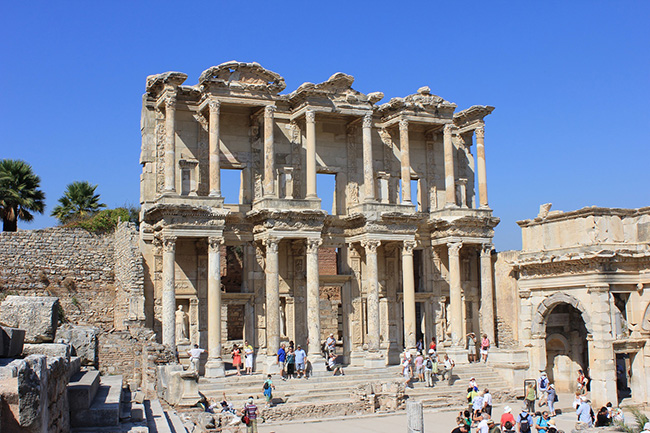
The Library of Celsus at Ephesus
'It is generally believed that Alexander sailed from Elaeus to the Achaean harbour, himself at the helm of the admiral's ship, and that half way over he slaughtered a bull as an offering to Poseidon and poured wine from a golden cup into the sea to propitiate the Nereids. There is a further tradition that, fully armed, he was the first to leave the ship and set foot upon the soil of Asia, and that he built an altar on the spot where he left the shore of Europe and another where he landed on the other side of the strait, both of them dedicated to Zeus, the Lord of Safe Landings, Athena and Heracles. Once ashore, he travelled inland to Troy and offered sacrifice to Athena, patron goddess of the city; here he made a gift of his armour to the temple, and took in exchange, from where they hung on the temple walls, some weapons which were still preserved from the Trojan War'.
Arrian, The Campaigns of Alexander, Book 1, 11
Arrian, The Campaigns of Alexander, Book 1, 11
THE TOUR
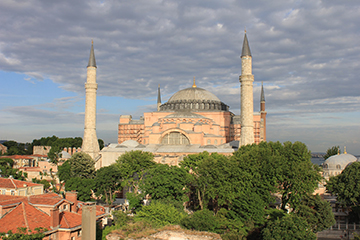
This 3-week Study Tour has an emphasis on the archaeology and history of Turkey, following the route of Alexander the Great. The tour begins in Istanbul where we explore the monuments around the Hippodrome including the famous Basilica Cisterns of Justinian. We also visit the impressive Haghia Sophia church, (dating to the mid-6th Century AD) one of the grandest structures to survive from ancient times. The following day we explore the treasures of the Istanbul Archaeological Museum, with an emphasis on the Hellenistic Period, and visit the Grand Bazaar.
The following morning, we travel to Gallipoli to see the ANZAC battle fields and memorials. We then cross the Dardallenes in the wake of Alexander the Great as he advanced into Asia to confront the Persians. We see the ruins of ancient Troy, where Alexander paid tribute to Achilles, and visit the site of the Battle of Granicus. The following day we travel south to Bergama, the great Hellenistic city, where we walk around the remarkable ruins of the acropolis with its famous theatre and temples. We next head to the ruins of the ancient Lydian capital at Sardis. The temple of Artemis is particularly impressive.
The following day we see the ancient Greek and Roman city of Ephesus with its superb theatre and famous Library of Celsus. We see the ruins of the temple of Artemis and also visit the Selcuk Archaeological Museum which contains a wide collection of artefacts from Ephesus. The following day we explore the picturesque ruins of the Hellenistic site of Priene, perched on a dramatic mountain overlooking the Meander River. Alexander arranged for the completion of the Temple of Athena. From here we head to Miletus, which Alexander had to 'liberate'. It is renown for its beautiful theatre. We also stop to see the ruins of the Temple of Apollo at Didyma.
From here we head to Bodrum (ancient Halicarnassus) which Alexander conquered. The site is famous for its theatre. We also visit the Castle of the Knights of St John which has a Museum of Underwater Archaeology. We then head south to Lycia where we see some of the famous ancient sites visited by Alexander. These include Fethiye (ancient Telmessus), Letoon, and Xanthos. We also see the very beautiful remains of the ancient cities of Olympos and Phaselis.
Next we travel to Antalya which will be our base for a few days to tour the local region. We see the extensive ruins of ancient Perge and the nearly intact Roman theatre at Aspendos. We also visit the seaside ruins of Side with its well-preserved theatre. The following day we explore the stunning mountain top ruins of ancient Termessos, where Alexander decided to carry on with his march. In the afternoon we see the remarkable sculpture in the Antalya Museum.
We depart Antalya, heading northwards. We stop to see the recently restored ruins of Sagalassos with its Roman theatre and impressive nymphaeum. We then travel by bus to Gordion where Alexander the Great cut 'the Gordion knot', an act which was said to have given him power over all Asia. We see the Tomb of Midas and the ruins of the ancient city. In Ankara where we see the impressive Mausoleum of Ataturk, father of modern Turkey.
Our tour next takes us to Cappadocia to see the superb 'Fairy Chimneys' composed of volcanic tufa. We explore the underground cities of the medieval period, including Goreme and Zelve. There is time in Cappadocia for an optional sunrise balloon ride. The tour ends in Istanbul. We explore the splendours of Topkapi Palace, home of the Ottoman court, and have a last minute walk through the extensive arcades of the Grand Bazaar, a shopper's paradise!

Alexander the Great
ITINERARY*
Day 1: Arrive IstanbulYou should arrive in Istanbul. In the evening we meet up with the group for dinner.
Day 2: Hippodrome - Basilica Cisterns - Haghia Sophia
In the morning we see the antiquities of the Hippodrome and the awe-inspiring Basilica Cisterns created by the Emperor Justinian. We have lunch in a nearby restaurant. The afternoon is spent in the magnificent Haghia Sophia church. Built by Justinian it was converted into a mosque after the Muslim conquest of Constantinople in 1453. Overnight Istanbul.
Day 3: Istanbul Archaeological Museum - Grand Bazaar
Today we head to the newly revamped Archaeological Museum in Istanbul. This contains a remarkable collection of artefacts from the period of Alexander the Great and his successors, including a famous head of Alexander from Pergamon and the Alexander Sarcophagus from Sidon. After lunch we visit the Grand Bazaar, the Egyptian Spice Bazaar, and the New Mosque. Overnight Istanbul.
Day 4: Gallipoli - Troy
In the morning we drive to Gallipoli and then cross the Dardanelle Straits where Alexander entered Asia with his army in 334 BC. We head to Troy where Alexander visited the tomb of his hero Achilles. We explore the ruins of this picturesque archaeological site famously excavated by German entrepreneur Heinrich Schliemann. We visit the site of the Battle of Granicus where Alexander first confronted the Persians. Overnight Canakkale.
 |
 |
Haghia Sophia in Istanbul |
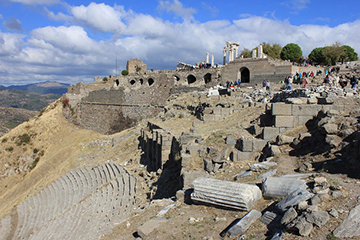
Pergamon |
Day 5: Pergamon
Today we head south to the ancient city of Pergamon. This Hellenistic city, founded by Lysimachus, one of Alexander's generals, is perched on the summit of a precipitous mountain and developed as a major centre of art and culture. Highlights of the day include the acropolis area with its royal palace, theatre, library and temple dedicated to the Roman Emperor Trajan. Overnight Bergama.
Day 6: Bergama Archaeological Museum - Sardis
In the morning we explore the small Archaeological Museum of Bergama which preserves magnificent sculpture and other artefacts from the local excavations. We also visit the Temple of Serapis (the 'Red Basilica'). We then head south to the ruins of Sardis, the ancient capital of the Kingdom of Lydia. We see the Temple of Artemis and ancient gymnasium. Overnight Selcuk.
Day 7: Ephesus - Artemis Temple - Selcuk Museum
In the morning we explore the magnificent Hellenistic and Roman site of Ephesus. We see the small theatre, the marble monuments of Curetes Street, the temple of Hadrian, the library of Celsus and the awe inspiring theatre. In the afternoon we stop briefly to look at the remains of the Artemis Temple, said to have been destroyed on the day of Alexander's birth. We also see the artefacts from the area in the Selcuk Museum. Overnight Selcuk.
Day 8: Priene - Miletus - Didyma
In the morning we travel south by bus to the ruins of the ancient Hellenistic city of Priene which is located on a dramatic hill overlooking the Meander River valley. This superb site includes a picturesque agora, town council hall, theatre, and Temple of Athena built by Alexander the Great. After lunch we visit the ruins of Miletus a highlight being the monumental Hellenistic and Roman theatre. Alexander was forced to besiege the town when they refused to open the gates. Heading south we stop briefly to see the spectacular temple of Apollo at Didyma. Overnight Bodrum.
 |
 |
The ruins of Ephesus |
Bodrum harbour |
Day 9: Bodrum
We spend the day in Bodrum (ancient Halicarnassus) which Alexander was forced to 'liberate' during his campaigns. In the morning we visit the ruins of the Tomb of the Persian Satrap Mausolus (the Mausoleum) and see the well preserved theatre. In the afternoon we explore the Knights Hospitaller Castle of St Peter and see the Museum of Underwater Archaeology. Overnight Bodrum.
Day 10: Fethiye
In the morning we travel to the beautiful port of Fethiye on the southern coast of Turkey. We explore the ruins of Fethiye (the ancient city of Telmessus) which include magnificent rock-cut tombs, and the ancient theatre. We also see the Fethiye Museum (if open) which has an excellent collection of sculpture, mosaics and pottery. Overnight Fethiye.
Day 11: Letoon - Xanthos - Patara
In the morning we visit the ancient sanctuary of Letoon which was named after the goddess Leto. We see the temples and wonderful theatre. In the afternoon we see the ruins of the city of Xanthos including the rock-cut tombs and the impressive ancient theatre. We also stop to see the ruins of ancient Patara which includes a restored theatre and bouleuterion. We then head to Kas, a beautiful port town with whitewashed houses. Overnight Kas.
 |
 |
The ruins of Phaselis |
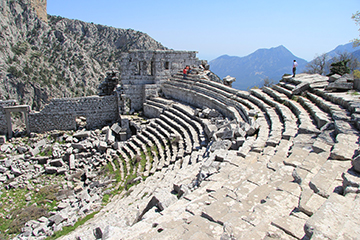
Termessos - the theatre |
Day 12: Myra - St Nicholas Church - Arykanda
In the morning we head east along the coast, stopping to see the rock cut tombs and theatre of Myra. Nearby we visit the very impressive 6th Century Church of St Nicholas (the origin of Santa Claus). After lunch we head into the mountains to visit the stunning site of Arykanda. This city prospered due to its location on trade routes and has a magnificent theatre, agora and bouleuterion. Overnight Demre.
Day 13: Olympos - Phaselis
In the morning we head to the spectacular ruins of Olympos an important Lycian town where the god Hephaistos was worshipped. We see the tombs, churches and harbour. We then continue on to the picturesque ancient site of Phaselis which is located on a wooded peninsula. Sights include a theatre, Roman baths and agora. In the afternoon we continue to Antalya. Overnight Antalya.
Day 14: Perge - Aspendos - Side
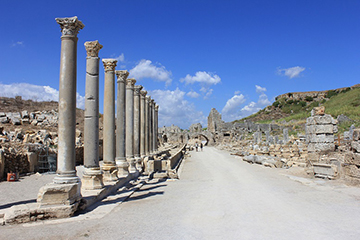
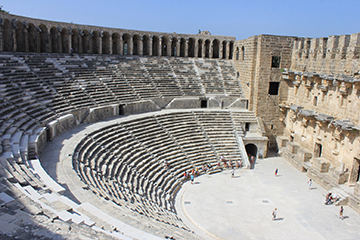
Today we explore a number of ancient sites located to the east of Antalya. Perge is an ancient city which includes a magnificent theatre, stadium, walls, agora and bath complex. We then visit the theatre of Aspendos, one of the best preserved theatre from antiquity. In the afternoon we see the stunning remains of the coastal city of Side. Overnight Antalya.
Day 15: Sagalassos
In the morning we head north of Antalya, passing though scenic countryside to Sagalassos. This ancient site has recently seen a major restoration and contains impressive Roman remains. Nearby, we see the Burdur Archaeological Museum which contains superb artefacts from Sagalassos. Overnight Antalya.
Day 16: Termessos - Antalya Museum
We head into the rugged mountains behind Antalya to visit the stunning Hellenistic and Roman city of Termessos. Alexander decided the city was too difficult to conquer and left it intact. This mountain top city has remains of many temples, gymnasium, council chambers and a spectacularly located theatre with views over the local valley. In the afternoon we visit Antalya Museum which has a stunning collection of sculpture. Fly to Kayseri. Overnight Urgup.
 |
 |
The ruins of Perge |
The Roman theatre at Aspendos |
Day 17: Cappadocia
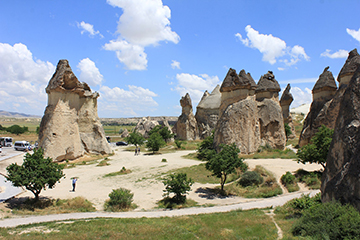
In the morning we visit the region of Cappadocia, famous for its remarkable landscape of natural 'fairy chimneys' made from volcanic pumice. In the afternoon we visit the old city of Uchisar and climb to the top of the pumice castle for a superb view over the whole of Cappadocia. Overnight Urgup.
 |
 |
The 'fairy chimneys' of Cappadocia |
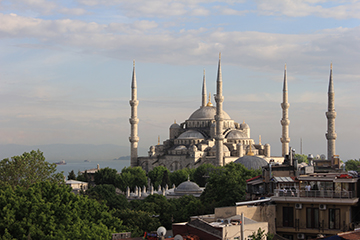
The Blue Mosque of Istanbul |
Day 18: Zelve - Goreme
In the morning we explore the ruins of the ancient settlement of Zelve, home to a monastic community in the Middle Ages. The inhabitants cut their houses and the monasteries from the local volcanic pumice and protected their dwellings by movable boulders. After lunch we visit Goreme to see the painted churches nearby. Overnight Istanbul.
Day 19: Topkapi Palace - Blue Mosque - Grand Bazaar
In the morning we explore Topkapi palace, the residence of the Ottoman sultans. We see the harem and main courts including the imperial treasury. In the afternoon we see the famous Blue Mosque and visit the Grand Bazaar for last minute shopping. Overnight Istanbul.
Day 20: Depart Istanbul
We board our plane for the flight back to Australia.
* Please note that the Company reserves the right to make alterations to the itinerary in the period up to 60 days prior to a tour departure. The itinerary may also be subject to minor re-arrangement due to the scheduling of the operators and availability of access. If this occurs, the Company will endeavour to provide a comparable alternative.